
When homeowners compare Ruud vs Goodman HVAC systems, they usually start with the brand name. That is understandable, but it is rarely the most important part of the decision.
Our honest answer is that a properly selected, installed and maintained system from either manufacturer can be a good investment. A poorly sized or poorly commissioned premium system can be disappointing. A simpler, correctly installed system can deliver reliable comfort for years.
This is not a laboratory reliability ranking. It is a practical contractor’s view of what Oregon homeowners should compare before buying.
The short answer
Ruud and Goodman both offer multiple equipment tiers, from relatively straightforward single- and two-stage systems to variable-capacity, communicating systems. Comparing only the brand names is therefore misleading. The exact outdoor unit, indoor coil or air handler, furnace, controls and duct system must work together as one matched installation.
If two proposals are otherwise comparable, we would place more weight on:
- the contractor’s load calculation and equipment selection;
- the condition and capacity of the existing ductwork;
- correct airflow and refrigerant commissioning;
- local parts availability and service support;
- the written labor warranty; and
- whether the system’s complexity matches the owner’s priorities.
The badge on the cabinet still matters, but it does not compensate for shortcuts in those areas.
Why installation can matter more than brand
ENERGY STAR states that improper HVAC installation can reduce system efficiency by as much as 30 percent. Its quality-installation guidance emphasizes correct sizing, airflow, refrigerant charge and duct evaluation. The U.S. Department of Energy likewise identifies equipment sizing and matching, charge, airflow and sealed ducts as core elements of a quality installation.
Those details affect more than a rating on paper. An oversized unit may short-cycle and control humidity poorly. Restricted return air, an undersized filter cabinet or restrictive ductwork can reduce airflow and increase stress on the blower. Incorrect refrigerant charge can reduce capacity and efficiency. Leaky or poorly insulated ducts can waste conditioned air before it reaches the rooms.
This is why two neighbors can buy equipment carrying the same brand and have very different experiences.
Ruud: practical strengths and questions to ask
Ruud’s current residential lineup includes furnaces, air handlers, air conditioners, heat pumps and packaged systems. Depending on the model, buyers can choose conventional equipment or higher-feature products that use Ruud’s EcoNet controls. Ruud advertises warranties of up to 10 years on parts and conditional unit replacement on eligible equipment, subject to the exact model, application, registration and written terms.
Reasons a Ruud proposal may be attractive include:
- a useful range of efficiency and comfort tiers;
- conventional and communicating choices;
- strong value when the local contractor has good distributor and parts support; and
- the ability to build an appropriately matched heating-and-cooling system rather than choosing one component in isolation.
Do not accept “Ruud system” as a complete description. Ask for every model number, the matched efficiency certificate when applicable, the control type and the warranty terms in writing.
Goodman: practical strengths and questions to ask
Goodman also offers both straightforward equipment and higher-end communicating or variable-speed products. Current heat-pump offerings, for example, range from conventional single-stage units to inverter-driven models using ComfortBridge technology. That breadth is useful, but it again means that a brand-only comparison is incomplete.
Goodman is often considered during value-oriented replacements. A lower equipment price should not be achieved by skipping the load calculation, reusing an unsuitable indoor coil, ignoring duct restrictions or omitting commissioning. Conversely, a fairly priced Goodman system installed carefully can be a more sensible purchase than a premium-branded system installed poorly.
As with Ruud, confirm exact model numbers, matched-system ratings, registration requirements, exclusions and the contractor’s separate labor coverage.
Communicating versus simpler equipment
Communicating and variable-capacity systems have real benefits. They can coordinate components, modulate output, maintain steadier temperatures, reduce sound at lower operating speeds and provide detailed diagnostics. For a homeowner who values premium comfort and accepts the added complexity, that can be worthwhile.
Our preference is often for simpler, non-communicating equipment when it can satisfy the home’s comfort needs. More sophisticated systems may use additional sensors, proprietary controls and electronic boards. When one of those components fails outside warranty, diagnosis and replacement can be more expensive than repairing a conventional system. Compatibility can also limit control substitutions.
That does not mean every communicating system is unreliable or that every conventional system is inexpensive to repair. It means complexity has a lifetime cost that deserves a place beside the efficiency rating. Homes with advanced electronic equipment should also have the electrical system evaluated and use protection appropriate to the equipment and manufacturer instructions.
Ask the salesperson to explain:
- Which components are proprietary?
- What happens if the communicating thermostat or main control fails?
- Are boards and sensors normally stocked locally?
- What are the parts and labor warranties?
- Can the system operate in a limited mode while a special-order component is unavailable?
Our candid view of other brands
We do not believe a logo alone determines whether a system will last. That includes Lennox, Trane, American Standard and other established manufacturers.
From our field perspective, the better-known premium names also tend to carry a higher purchase price. We are less enthusiastic about Lennox because certain replacement parts can be costly. Trane and American Standard are not our first preference, although that is a preference rather than a claim that their equipment is inherently poor. With any brand, local parts access, the precise model and the installer matter more than an internet argument about whose name is on the cabinet.
Homeowners should be skeptical of anyone claiming that one manufacturer is always excellent or another is always terrible. Product lines change, individual models differ and the installation conditions in the home remain decisive.
Consider the manufacturer’s other brands—not just its premium badge
Large HVAC manufacturers often sell equipment through several brands and price tiers. A homeowner who likes the engineering and corporate support behind a major manufacturer may not need to buy its highest-priced nameplate.
For example, Allied Air is a Lennox International company whose residential brands include Armstrong Air, AirEase, Concord and Ducane. Trane Technologies lists Trane and American Standard alongside more value-oriented residential brands such as RunTru, Ameristar and Oxbox. RunTru describes its equipment as designed, built and tested by Trane, while Trane Technologies describes Oxbox as a no-frills line endorsed by Trane.
These affiliated lines deserve consideration, particularly when they provide the efficiency and features a homeowner actually needs at a lower installed price. They can be a sensible way to avoid paying primarily for premium positioning or features that offer little value in a particular home.
Corporate ownership, however, does not make two brands identical. An affiliated value line may use a different cabinet, component set, control platform, efficiency range, warranty, distribution channel or parts system. Dealer training and local inventory can also differ. Buyers should compare exact model numbers and written terms rather than assuming that a lower-priced unit is either “the same machine with another badge” or an inferior product.
When evaluating an affiliated brand, ask:
- Who manufactured the equipment and who administers its warranty?
- Are the parts stocked by local distributors?
- Does the proposed model use standard or proprietary controls?
- How do its registered parts and unit-replacement terms compare?
- Is the installer’s labor warranty the same as on the premium-brand proposal?
- Which efficiency, sound or comfort features are being given up to reach the lower price?
If the value-line system is properly sized, supported locally and installed to the same standard, the money saved on the badge may be better spent correcting return-air restrictions, sealing ducts, improving filtration or purchasing stronger labor coverage.
A real mixed-brand system from the field
The equipment shown below is a real residential system we inspected: a Rheem gas furnace connected to Goodman cooling equipment. The furnace is model RGRS-07EAMGR. Its rating plate gives a manufacture date of June 2010. The Goodman outdoor air conditioner is model VSX130481AB, manufactured in September 2012, and the Goodman indoor evaporator coil is model CHPF4860D6DB, manufactured in August 2012.
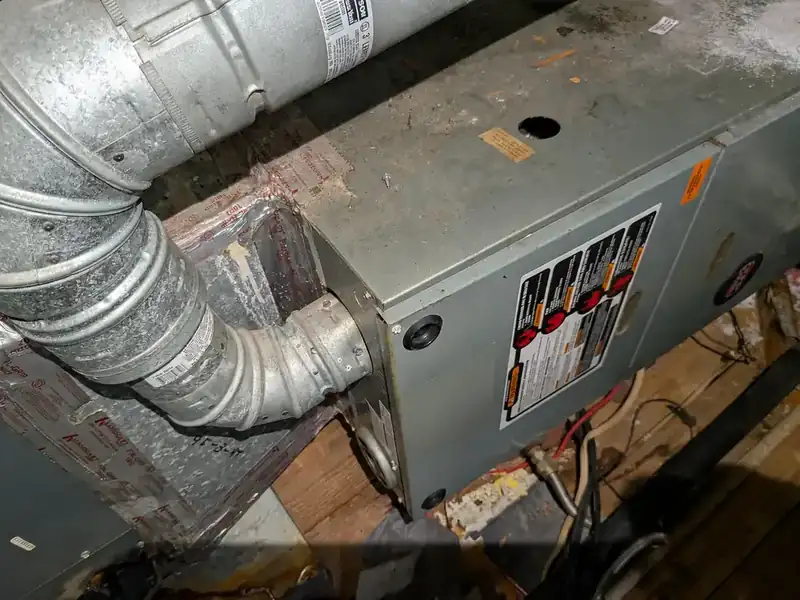
That makes the furnace approximately 16 years old and the cooling equipment approximately 14 years old as of September 2026. These are manufacture dates, not confirmed installation dates; equipment can sit in inventory before it is installed.
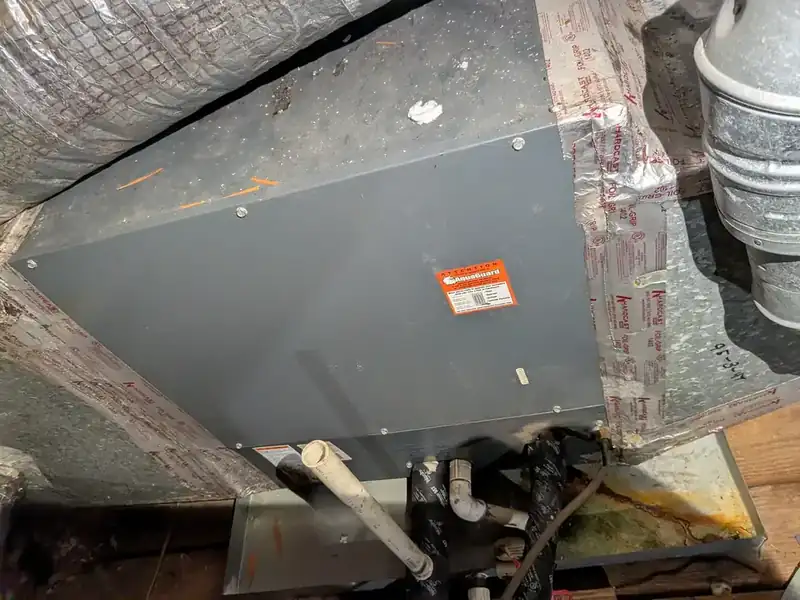
This is a brand-mismatched, mixed-age system: the furnace and cooling equipment were not supplied under one brand, and the furnace predates the air conditioner and coil by a little more than two years. That fact is worth documenting, but different badges alone do not prove the cooling combination is technically incompatible. The outdoor condenser and indoor coil are both Goodman products. Confirming the rated efficiency and approved combination requires the complete component data and applicable AHRI certificate, while confirming field performance requires airflow, refrigerant and static-pressure measurements.
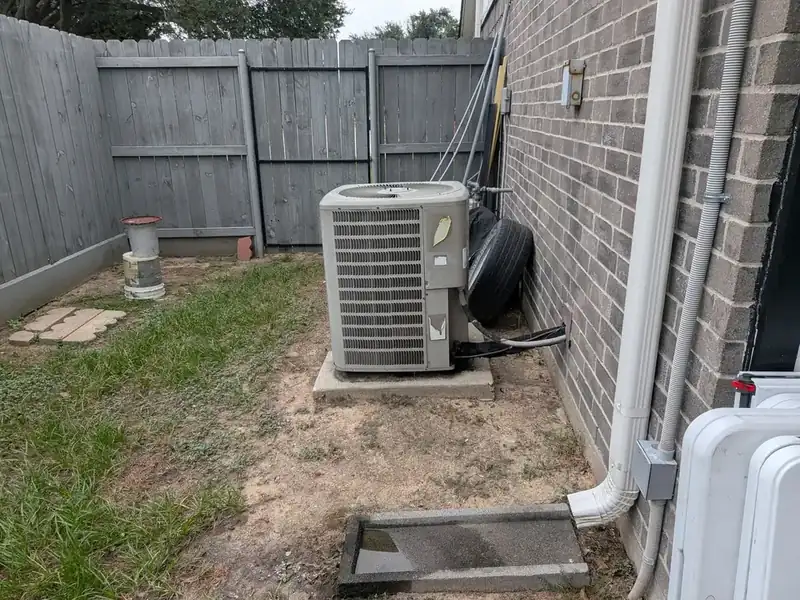
This example reinforces the central point of this review. Homeowners should evaluate the complete installed system—equipment pairing, blower capability, coil, controls, refrigerant setup and ductwork—not assume that one brand name tells the entire story.
Existing ductwork can make or break the new system
A replacement proposal should not treat the ducts as invisible. Learn more about our HVAC and ductwork services. The contractor should evaluate return-air capacity, supply distribution, leakage, insulation, filter resistance and airflow through the indoor equipment. DOE research notes that existing duct design, leakage and insulation can complicate efficient HVAC operation, and that advanced equipment is still susceptible to airflow, charge and duct faults.
Sometimes the existing ducts are serviceable with sealing or modest corrections. Sometimes a new high-capacity system cannot perform properly without larger returns, revised transitions or other duct improvements. The correct answer depends on measurements, not assumptions.
The comparison that homeowners should request
Ask each bidder to put these items in writing:
- complete outdoor and indoor model numbers;
- heating and cooling load calculations or a clear sizing basis;
- matched-system efficiency documentation;
- duct and return-air findings;
- required electrical, drain, pad and line-set work;
- filtration type and replacement size;
- thermostat and communication requirements;
- start-up and commissioning measurements;
- manufacturer parts, compressor and replacement-unit terms;
- contractor labor warranty;
- permit responsibilities; and
- expected maintenance and filter costs.
Then compare equivalent tiers. A basic single-stage Goodman should not be judged against a premium variable-capacity Ruud as though the brand were the only difference.
Our verdict
There is no universal Ruud-versus-Goodman winner. We would rather install the right-sized, serviceable model supported by sound ductwork and careful commissioning than sell a more complicated system simply because it has a higher rating or more features.
For many homeowners considering a heat-pump installation or other HVAC replacement, the best value is a proven, non-communicating system with readily available parts, good warranty support and an installer who will measure and verify its operation. For others, the quieter operation and tighter comfort control of variable-capacity equipment justify the added cost and complexity.
The best proposal is the one that explains those tradeoffs honestly and treats the house—not just the equipment box—as a complete system.
Sources and further reading
- ENERGY STAR: Clean Heating and Cooling
- ENERGY STAR: HVAC Quality Installation
- U.S. Department of Energy: HVAC Quality Installation
- Ruud: Endeavor Line
- Goodman: Heat Pumps
- Allied Air: About the Lennox International company and its brands
- Trane Technologies: Our Brands
- RunTru: Heating and Cooling Equipment Backed by Trane
Editorial disclosure: This article reflects The Duct Guys’ practical service and installation preferences. Warranty coverage and product specifications change; confirm the current written terms for the exact model before purchase.